Got good news in our research. Maybe this is one of the very first open responses to the idea of 3D screens of speakers that I have seen — at least the public news doesn’t show much yet, and it is curious how the “no-more-models” camps have been evolving. I am absolutely sure that BiAmp and other players are doing their homework and will suddenly come up with solutions of this kind.
My always big question is why the EAW Anya, which featured something like twenty-two drivers each one — why did they never go 3D. Well, we are going 3D, starting by studying 2D.
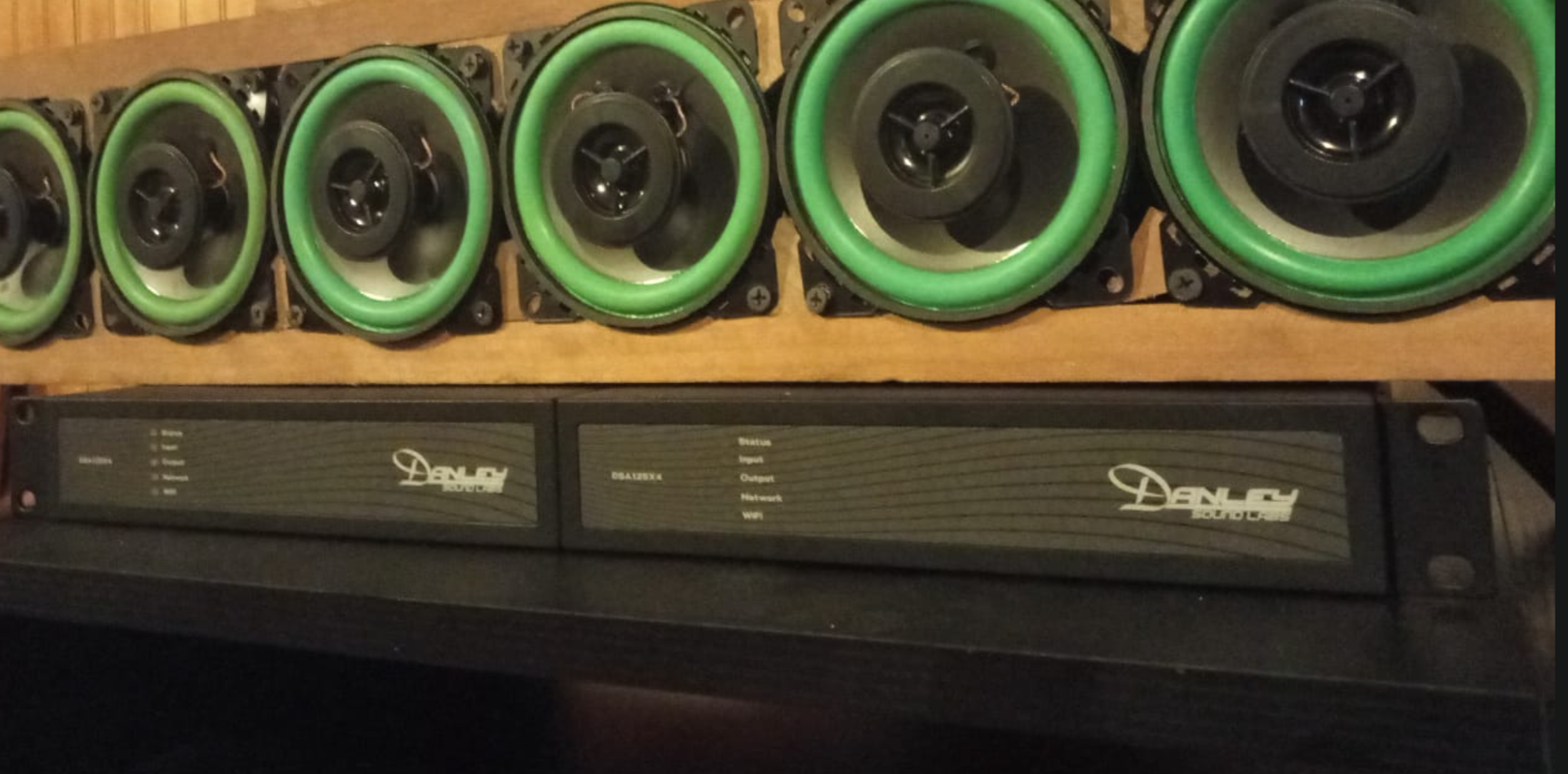
I don’t know if there is already, in the open, a 3D-screen-of-speakers feature that sends more than one signal to different spaces at once. We have it covered — at least part of it. As you will clearly appreciate on the video I’m attaching with this report, two signals play to two different directions from the same column of drivers.
It is a milestone. I love to hear and experience sound, and to see how every time the simulation correlates and is just useful.
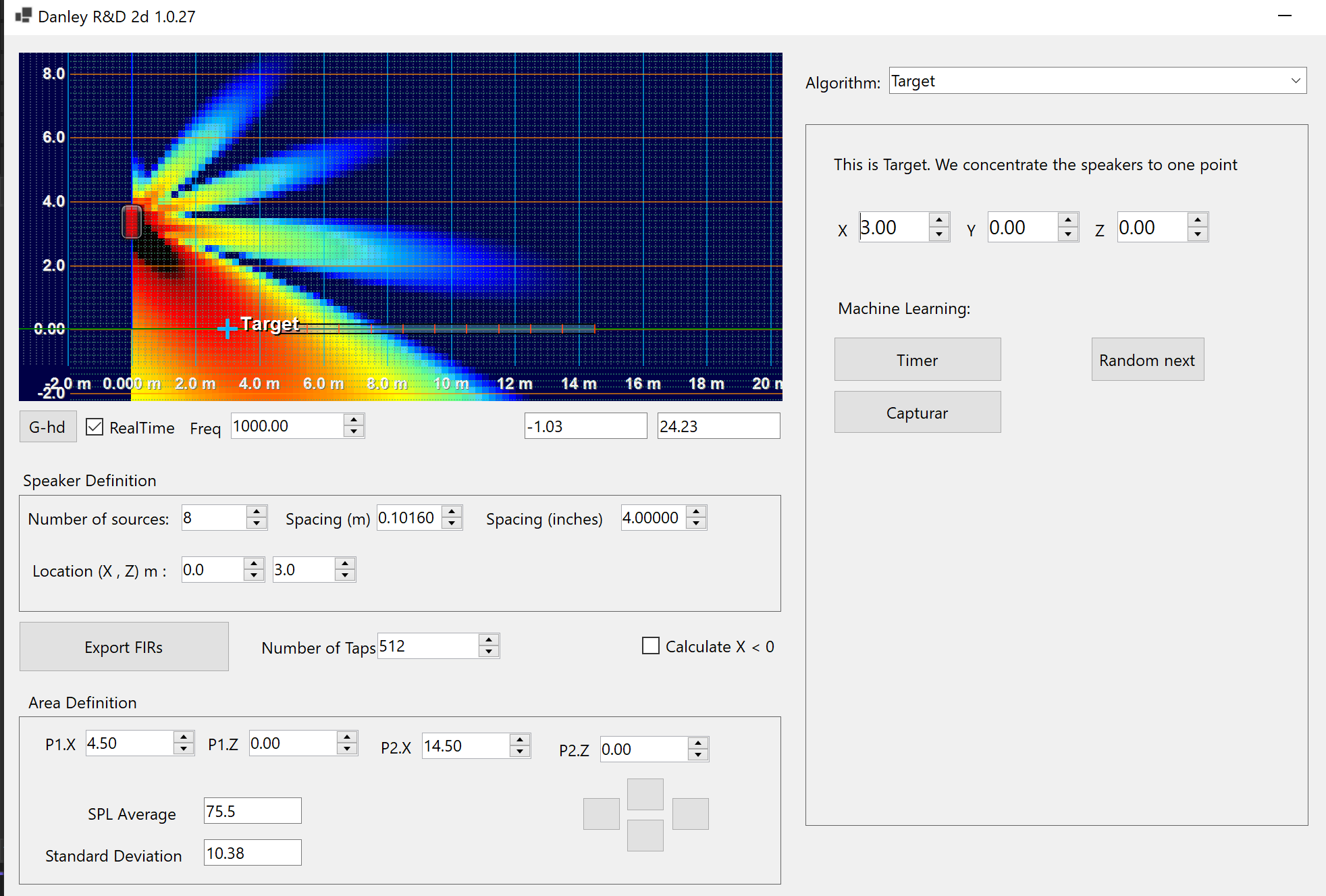
One beam pointing one direction. The column is steered with a set of eight FIRs generated by our existing tools and loaded into the machine.
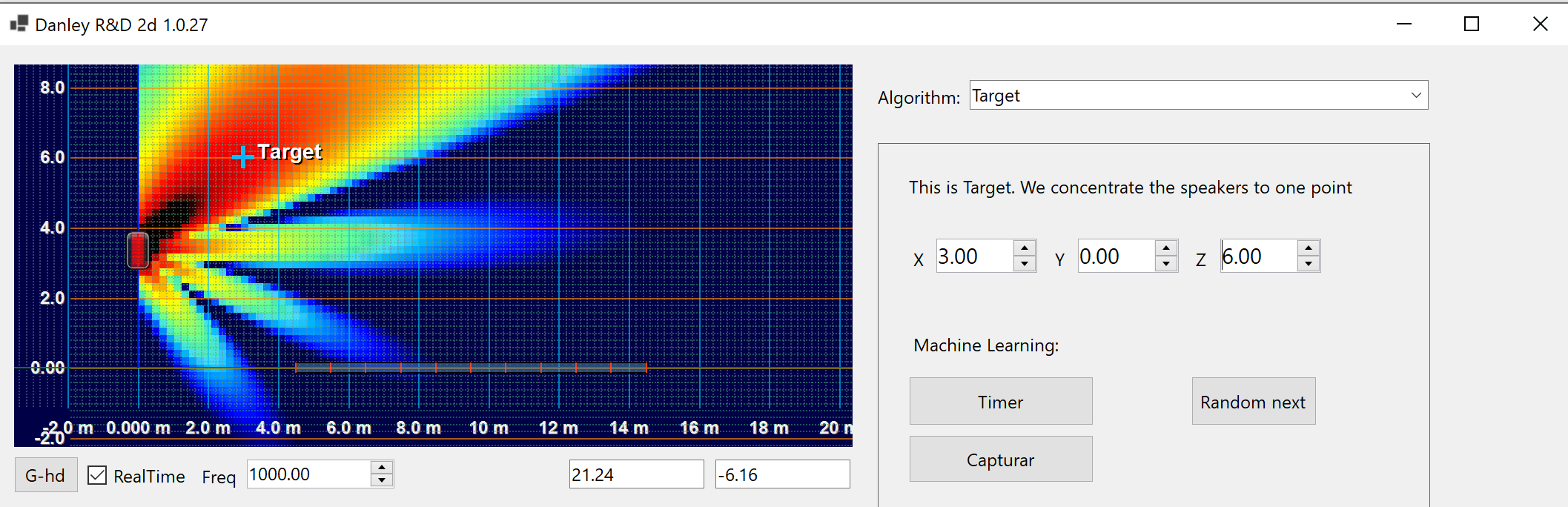
Inverted, for the second set of data. A second processor receives the mirror set of FIRs; the same drivers now serve a second listener.
How it was done.
I used our current existing software to generate FIRs which are loaded to the machine — and physics doesn’t lie. We are blessed to have this sound lab to create stuff: I mean Direct2 and the new software here for FIR generation and algorithm testing. Anyway — very directional beams were used, one of our existing algorithms.
For each situation the tool generates the eight needed FIRs for each source on the 2D column. The story goes on like this: I got two processors working separately, each of them using the corresponding set of FIRs. Their signals came from different material and sources — two PCs. Then I just summed passively their outputs to be able to go with the eight sets of two signals. My guy made me eight Y cables, XLR. The videos are very interesting.
Latin band on one side, Phil Collins on the other — and more.— from the listening session, Feb 04
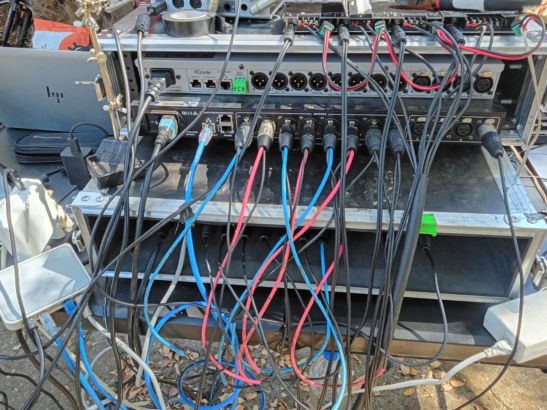
The listening session. Italian Eros Ramazzotti and Corona played on the second pass — different audiences hearing different programs from the same column.
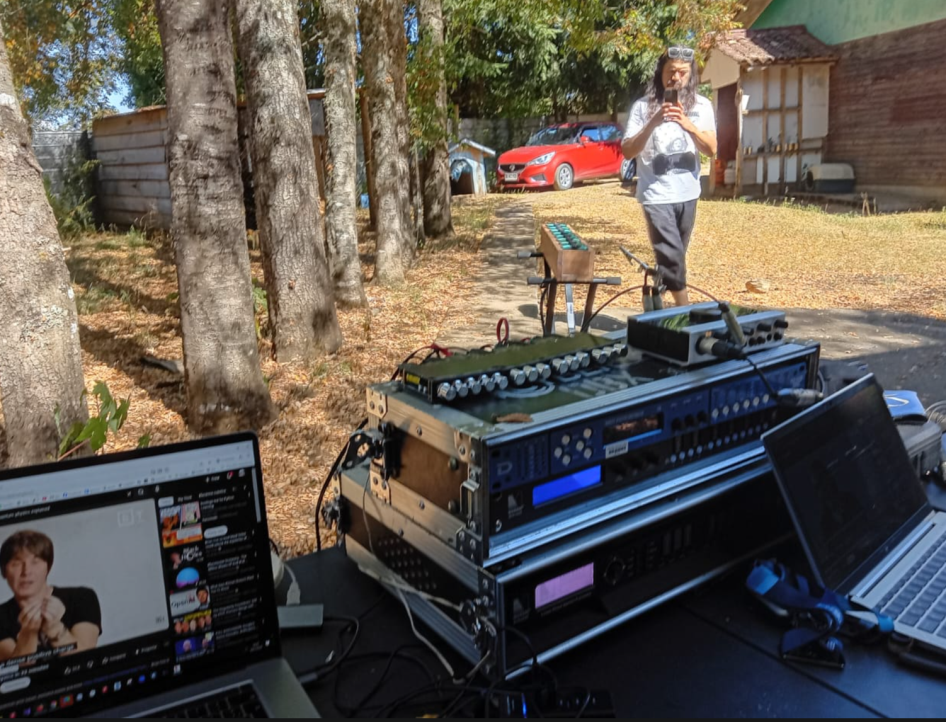
Leo — my audio guy — present at the experiment. The bandwidth is narrow on this prototype because the unit lacks smaller speakers; the 2-way version is next.
Of course, the bandwidth is very narrow because the unit lacks smaller speakers — but we will of course do the 2-way version. Or maybe we jump to 3D. There is some time from here to where I can freely ask for specific functions to Linea Research or to the other guys in your lands. So we can learn a lot with 2D advanced functions. I have seen no other player showing this.
Maybe you can even sell this for emergency systems with the catchy thing that, for some people, it sounds in Spanish, and for others, in English. I see even an HD video around a beautifully crafted 2-way horizontal prototype. Not to say that this could also be an ultra-cool consumer device — a lot of one-inch drivers allowing cool effects even in front of a TV. The father listens to football, the daughter to something else. Or also the art of producing “silenced” places.
The science is advancing — and it is Danley science.
What comes next.
More has to be resolved. I will start trying crazy things — like actively muting lobes — but this is also for the future. The first unit should be a simple X,Y grid of drivers. The advanced unit has 2X·2Y drivers in a 2-way. I have had, from a long time ago, the idea of the high-frequency drivers together in one corner, to be able to sum up to four units without losing minimum separation between drivers.
Muting lobes is very advanced. I have done all the homework to know how this is achieved — it’s Linux, with a procedure called convolución FIR particionada por FFT. Partitioned. Way cool. For the moment, just have fun with the experiment. This is easily replicable by you there.
The control software is key on the Digital Horn. It is the house in which our program runs. The user sees a device, presses a button, is prompted to an instance of the device, draws their audience areas — and the control program receives the dataChunks (FIRs) and loads them to the channels.
Also, there is a little video about how we are covering audiences in any shape automatically. On my head we can also send multiple different beams of the same signal in different directions. I have already tested this with pure-tone lasers — and as always, physics never lies.
I have had a fruitful conversation with Tom about all this stuff, summed to their new lens — and me, giving him specific tools for his research.
Muy interesante, eh.
— Saludos.