We do this kind of important measurement outdoors, on a flat, open space. The place I measure is flat and free of reflections within 600 ft around, surrounded by trees and no reflective surfaces.
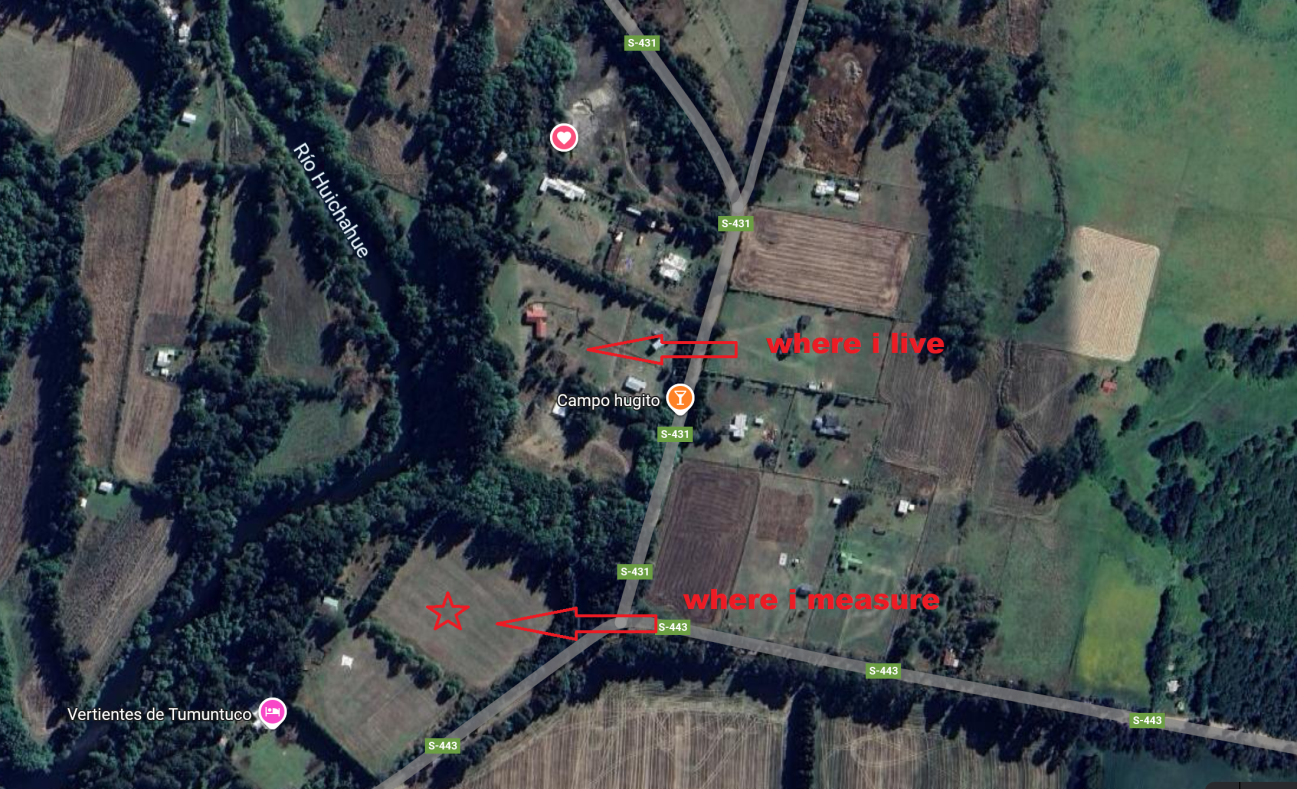
The measurement site — flat ground, a ring of trees, no reflective surfaces for six hundred feet. A quiet field, chosen for truth.
Why horizontal, on a turntable.
For research purposes — and to avoid even the floor's soft reflection — I do this with the system horizontally, over a rotating turntable.
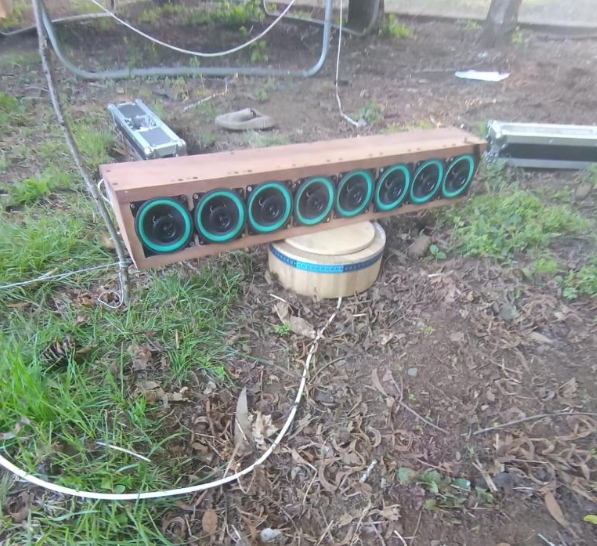
This is the way. The mic is also near the floor. The system is an 8 × 4" line I built for research — the transducers are cheap and wearing out; the next unit will use real-world drivers like Faital.
The array points to the sky. From the side, it is omnidirectional.— the omnidirectional measurement method
Why 2D first, when the goal is 3D.
One can wonder why to build a 2D speaker if the project of the Digital Horn is a 3D speaker. There are several advantages. The first is that it is completely coherent to start first with 2D and then go 3D — first walk, then run. On the other hand, at the moment we only have 8 output possibilities at hand, processor-wise. I have a Marani to test, which has the possibility of loading, with one button, 8 FIRs to the 8 outputs.
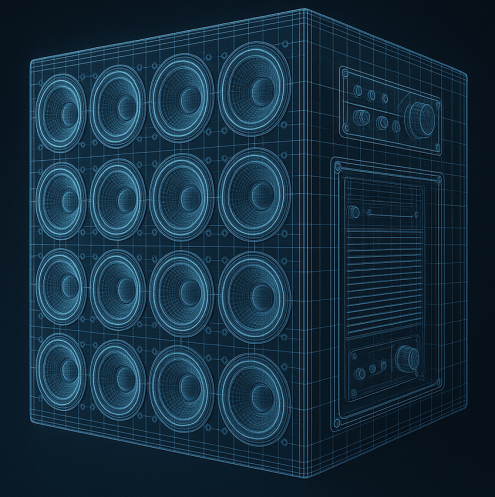
The 3D Digital Horn, as it will be. But we study 2D first, because 2D teaches everything we need before we scale.
As talked with Mike, we will soon have this possibility with Linea and the new American amplifier partner.
What the first measurements are for.
We will start as simple as measuring the polar pattern of the unit and comparing it to simulation results. The natural response — no algorithm on any driver — should be like this:
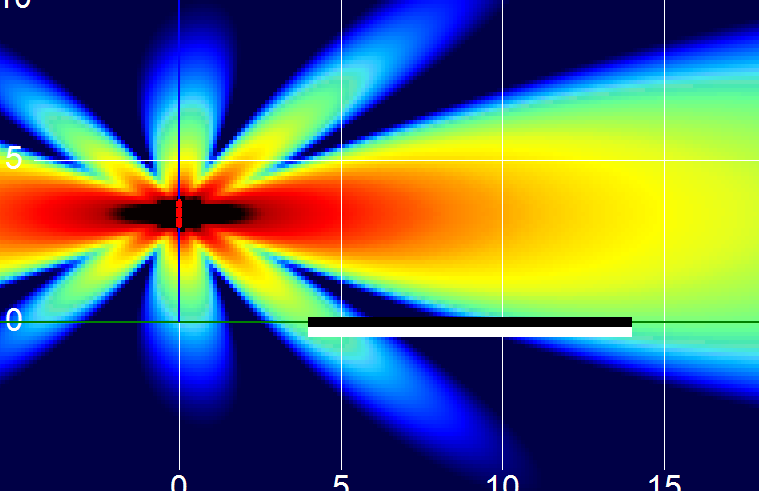
1 kHz natural response — no processing on any of the drivers. This for a 4" driver. And we will do that for many frequencies.
Focal approach — the key algorithm.
Then we will do the same but for some basic and advanced algorithms. For example, the focal approach, where all the energy of the drivers is concentrated at one point.
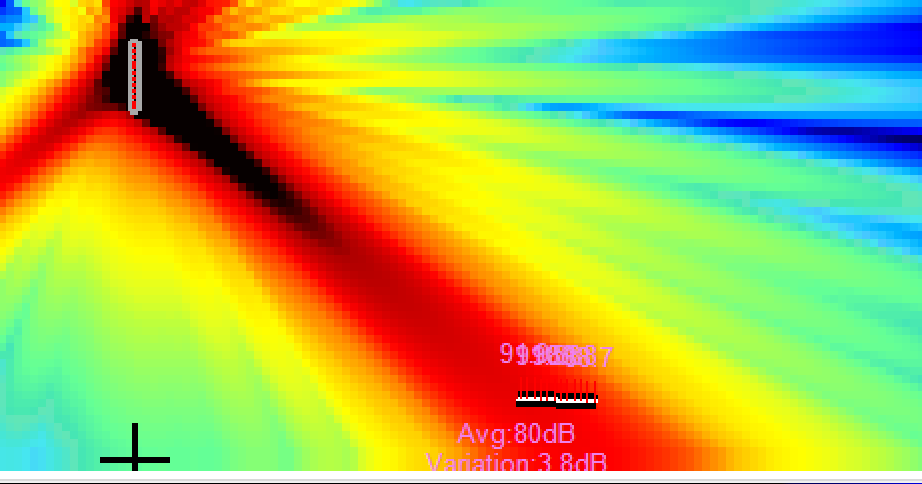
The focal approach. This will play a key role in future, more advanced techniques of active muting of non-desired lobes.
As this yields results, we will measure other, more advanced algorithms. We have talked about "algorithms" — that is what the next number of these diaries will talk about. We are preparing ourselves for the first measurements, but in the meantime, advancing in theory and putting all the science into these diaries will be handy for the future.
Till next.
— Sebastián.