We know sooner or later we will be working with our partners' hardware — Linea, the new American — and using reliable drivers, maybe Faital. Anyway. As I'll explain later on in these diaries, 2D research is equal in importance to 3D. And in 2D we already have ways to send eight different convoluted signals to our own box, which I call Agata1.
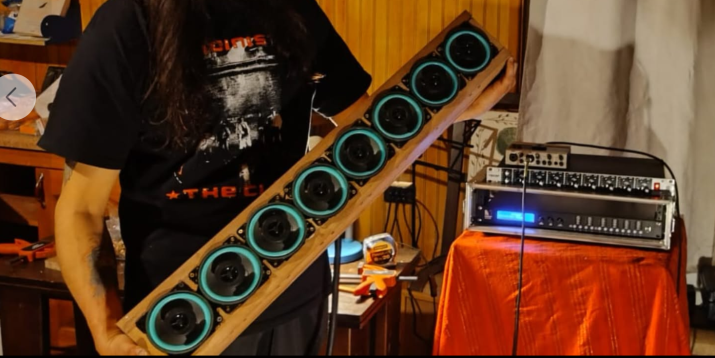
Agata1. Several drivers were destroyed — bad quality, not rigid — although very suitable for our experiments, given their equal sensitivity and equal response in both phase and magnitude.
Thinking on testing with some little "egg"-like speakers these days, preparing gear for research measurements on free field. For me, measured results are the most important thing — always.
Building the Focal approach by hand.
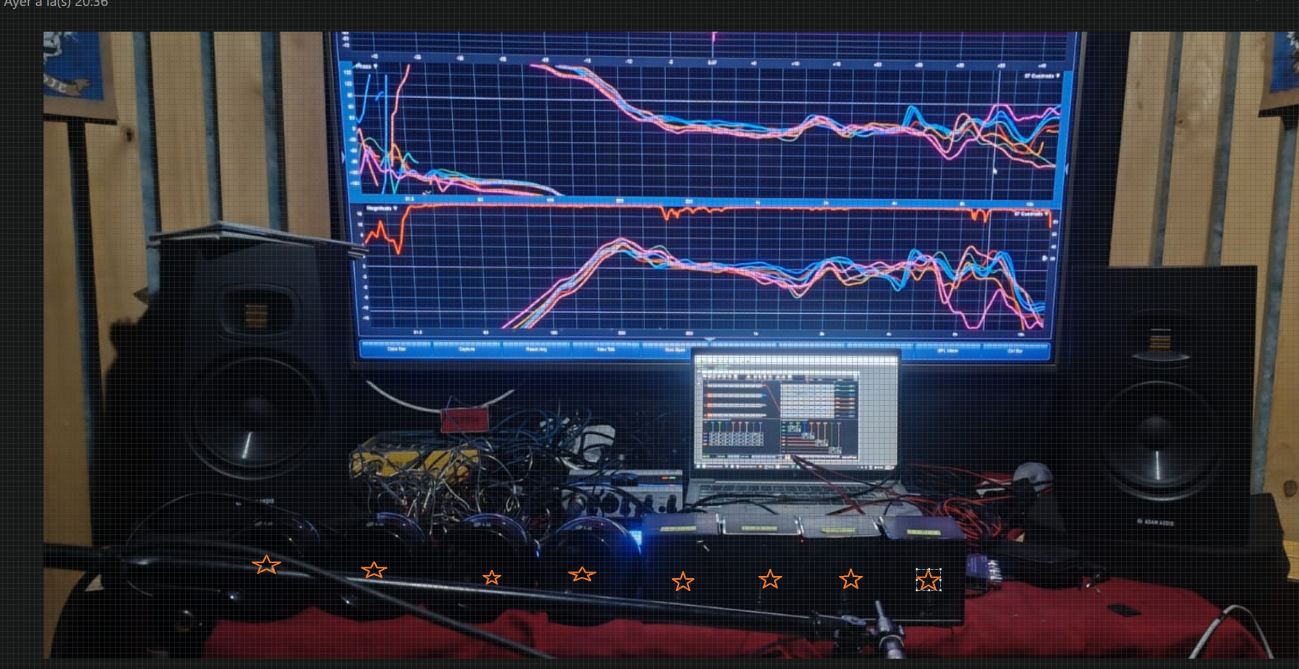
Each star a source. We created, by hand, the Focal approach.
As simple as measuring time and phase on a given point for each transducer, then applying the individual delay. Thus, the 8 sources get to the measurement point at the same time. This is the Focal algorithm. Again — very important for the advanced techniques to come. To create a focal approach, you just have to sync N signals on a given point.
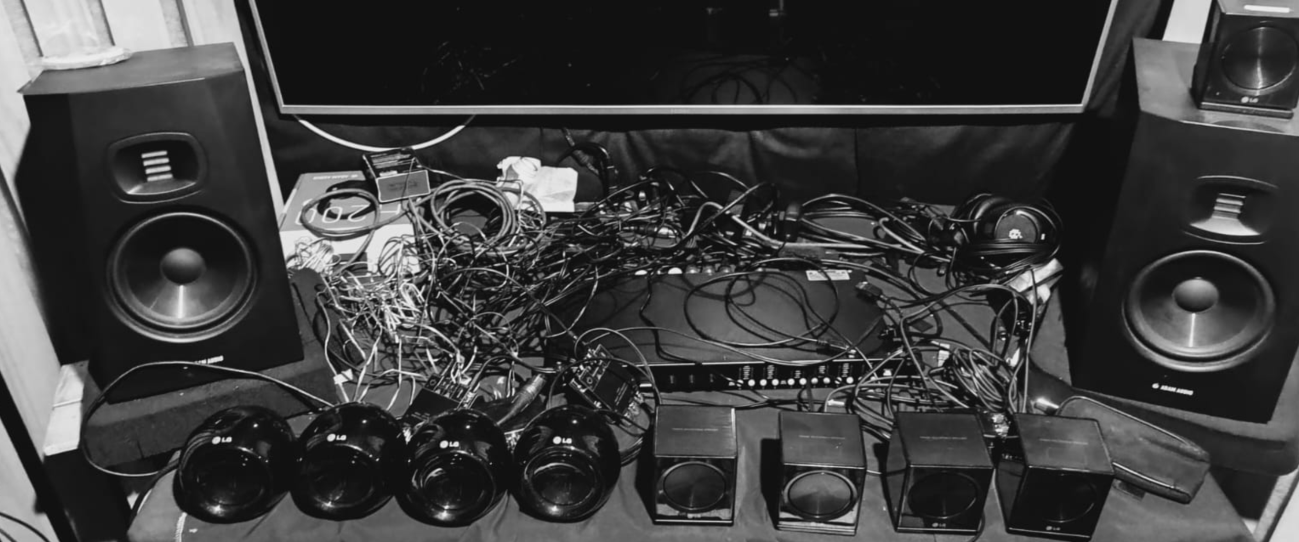
What a mess with cables. The bench on the day of the ritual.
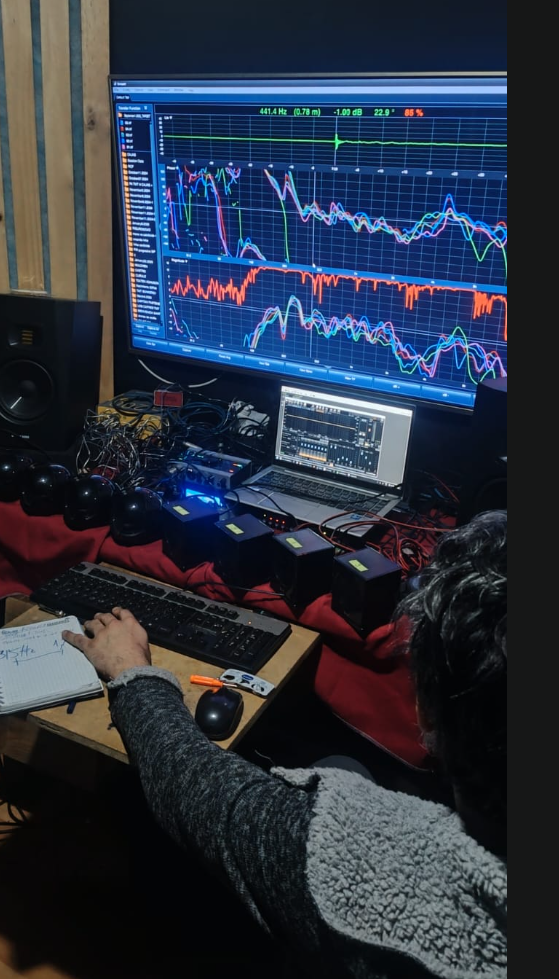
Aligned to a point, the 8 little folks. The room is Leo's shop — Leo is a friend, very cool guy. The room was incredibly absorptive — at a certain frequency range we got −20 dB walking three metres into the room.
I am very soon expecting to measure in controlled conditions, but there will be rain. Meanwhile, I am setting up the DANLEY tools for research, and not using old, inferior tools.
A separate, even isolated piece of code — given sources and audiences — always produces DSP instructions.— the working definition of an algorithm
A common language.
I want us all to understand, more or less, what this will be doing. I will now repeat myself on the simple idea of "algorithm". We will be proud of making ourselves a kind of common language. The algorithm is the important thing in a 2D column or a 3D speaker — the Digital Horn. The algorithm is a separated, even isolated piece of code that, for a certain bunch of data — sources, their N locations, their gain/delay or transfer function (impulse), their frequency response and polar balloon, and on the other hand audience areas with their locations and sizes — takes all this data and always produces DSP instructions. (This DSP, for the moment in our endeavour, will be a FIR.)
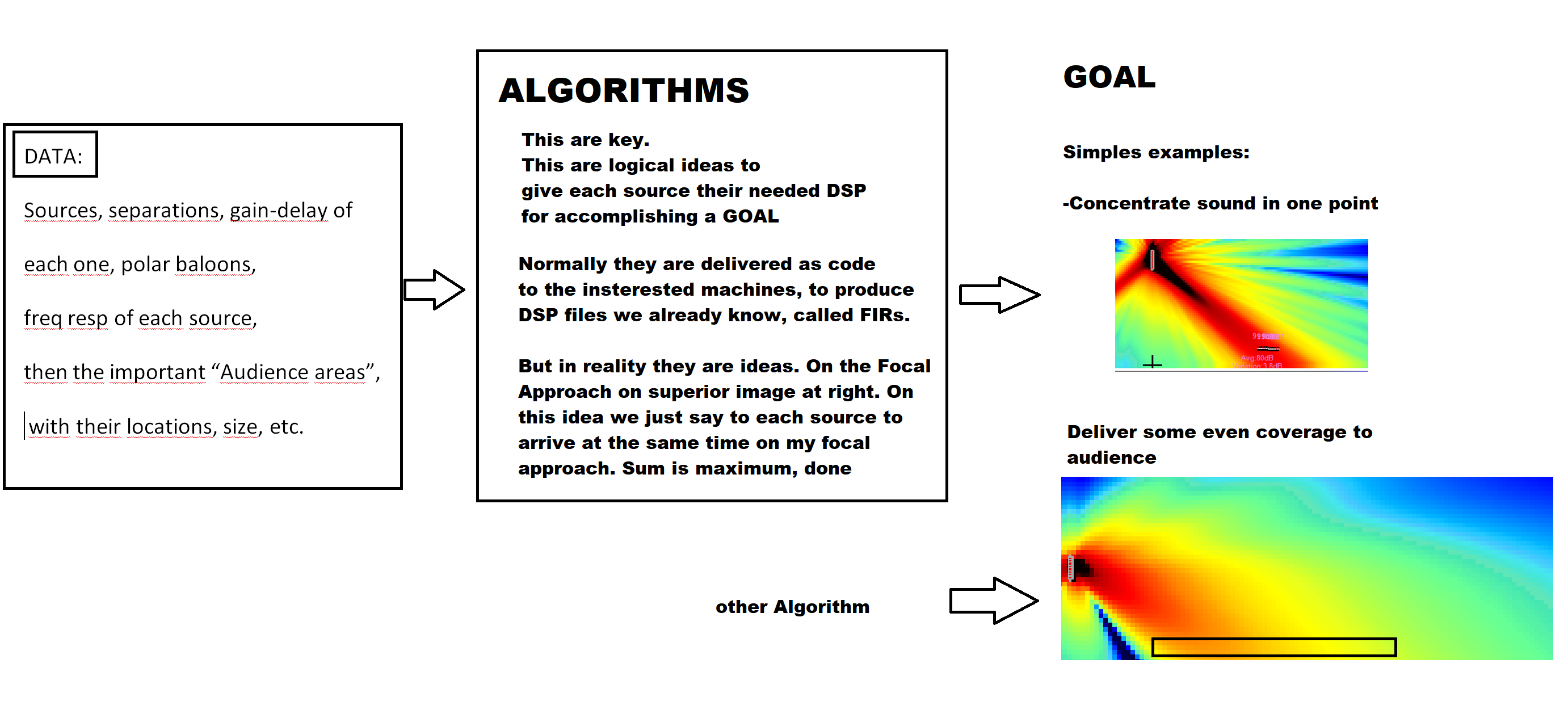
Visually, that is how I would explain it — inputs above, machine in the middle, DSP instructions below. The algorithm is the machine.
Rigour test.
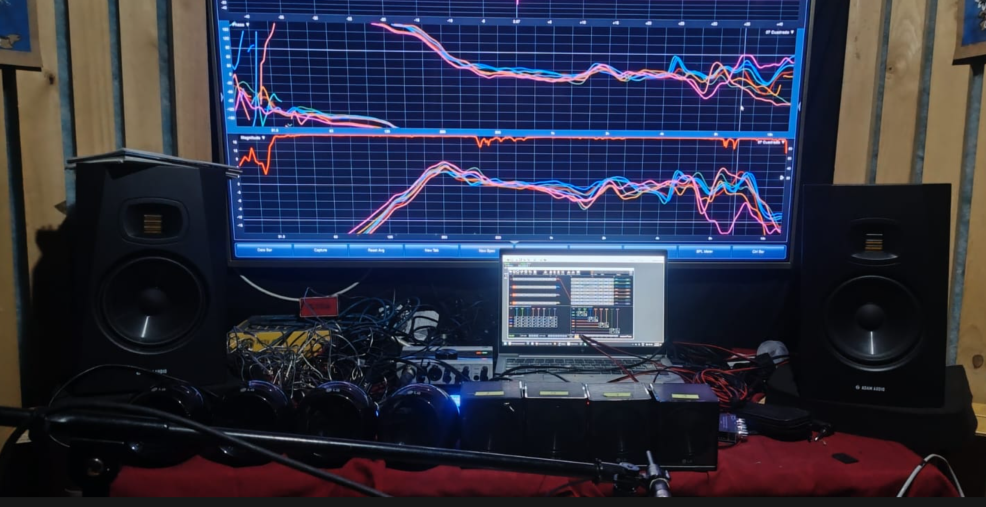
Separated sources as seen in the effort with my guy Leo.
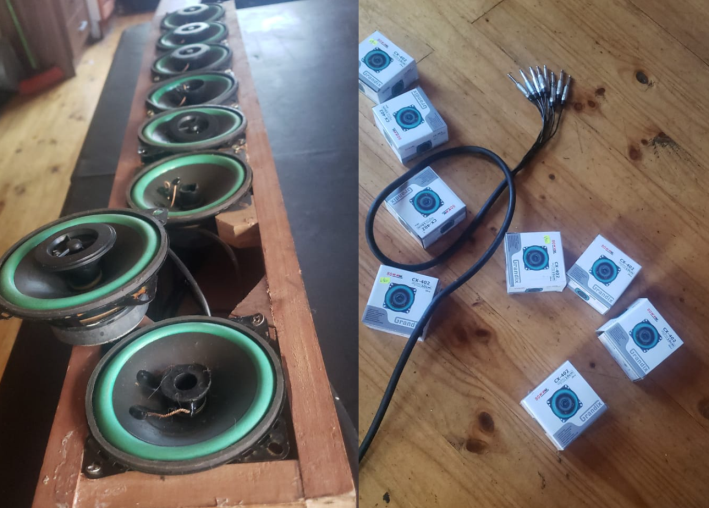
Rigour test. Same power on each source — then the mic in front of each of them, to check the best linearity or "equalness", in magnitude and phase. On this measurement they have a good, very good frequency range, like from 200 Hz to 4 or 5 kHz. I acquired the 8 new transducers, and we are preparing the Agata1 unit to sound coherent again.
On hardware.
I have access to an 8-channel processor FIR unit, but not freely to work in peace — only sometimes I can use it. I need a Linea Research or new-partner unit with 8 outputs of FIR. There is also the innosonix solution, and I think maybe cheaper than all that is to buy another processor of the same brand I already get to use sometimes — Marani, around 1500 USD, available in Chile.
Now, as I am in the winter season, it is cold and rainy right now — so in about a week we will go for the measurements with cool stuff. Meanwhile, I will advance with our own 2D state-of-the-art lab for algorithms and show you more science.
— See ya.